
Will Rousey vs Carano Actually Make Money — And Does It Even Matter?
A high-stakes breakdown of MVP’s first major move into MMA with Rousey vs Carano on Netflix, examining whether the event can actually turn a profit and why that might not even be the point.
LANDING PAGE
Tony Caramello
3/13/20265 min read
Setting the Stage
The announcement alone tells you what this is.
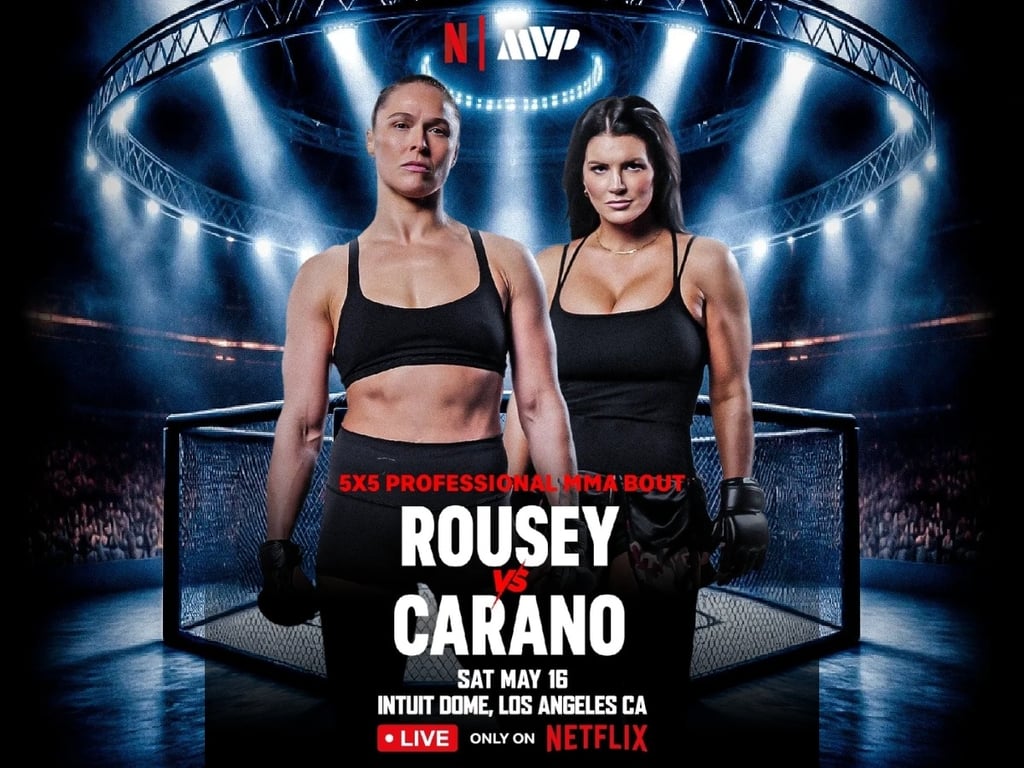
Ronda Rousey vs Gina Carano. Intuit Dome in Los Angeles. Streaming globally on Netflix.
That’s not just a fight card, it’s a statement. For years, people have talked about what a true non-UFC mega-event could look like in MMA. Not just a solid card, but something that pulls in casual fans, commands mainstream attention, and actually feels big outside of the UFC ecosystem. This is probably the closest we’ve gotten.
And it’s not happening on pay-per-view, which is where things really shift.
This card, backed by Most Valuable Promotions and distributed by Netflix, isn’t built around squeezing incremental revenue out of fight fans. It’s built for a streaming ecosystem where attention is the currency. That changes how you measure success from the start. MVP is stepping into MMA with an event-driven model they’ve already proven in boxing, while Netflix, with over 300 million subscribers, is actively trying to figure out what live sports looks like on its platform.
The card itself reflects that strategy. Rousey vs Carano, Diaz vs Perry, Ngannou on the same night. It’s a mix of nostalgia and legitimacy designed to pull in both casual viewers and hardcore fans. The problem is that kind of appeal doesn’t come cheap.
Which leads to the real question: does this actually make money?
Can This Event Actually Make Money?
To understand the economics, you have to start with how MVP is structuring the revenue. This isn’t a traditional fight business model. There’s no PPV upside, no late-cycle surge based on demand, and no real mechanism for the event to outperform expectations financially once the deal is signed. The Netflix rights fee isn’t a bonus, it is the business model.
Everything else sits underneath it. The gate at Intuit Dome probably lands between $8 million and $15 million if priced aggressively. Sponsorships and integrations could add another $10 million to $20 million depending on how well Netflix activates its brand partners. VIP experiences and merchandise might bring in an additional $3 million to $5 million. At best, you’re looking at $20 million to $40 million in non-Netflix revenue.
That sounds solid until you factor in the cost side, because this isn’t a lean build. It’s a true supercard. Fighter pay alone is likely in the $40 million to $70 million range when you factor in Rousey, Carano, Diaz, Perry, and Ngannou. Production and venue costs at a place like Intuit Dome can easily run another $10 million to $20 million, and marketing a global Netflix event is another $10 million to $20 million on top.
Now you’re sitting somewhere between $60 million and $100 million in total cost, which brings everything back to a single number: the Netflix check. MVP probably needs somewhere in the $40 million to $60 million range from Netflix just to break even.
If Netflix comes in light, this is likely a loss. If they come in strong, MVP might squeeze out a narrow profit. If they decide to be aggressive because they see long-term value, then there’s real upside. But there’s no real margin for error.
That’s the structural challenge. In a traditional PPV model, revenue scales with demand. If the fight catches fire, you benefit directly. Here, revenue is fixed while costs remain high and inflexible. MVP is essentially locking in its upside while still taking on superstar-level expenses.
From a pure event perspective, that’s a difficult model to sustain. But I don’t think this event is being judged purely on event-level profit.
Netflix Isn’t Buying a Fight, They’re Buying Behavior
From Netflix’s perspective, this isn’t about whether Rousey vs Carano generates a clean profit on paper. They’re evaluating something different entirely. They care about how this event impacts user behavior across the platform.
Does it bring in new subscribers? Does it reduce churn? Does it create a spike in engagement that strengthens their pricing power over time?
That’s the real equation.
Live sports offer something Netflix doesn’t naturally have, which is urgency. You have to watch it live or you miss the moment. That’s incredibly valuable for a platform built around on-demand consumption. If this event drives a meaningful global audience, even if part of that is fueled by nostalgia, it becomes a proof of concept.
And once that proof exists, Netflix can start thinking bigger. Recurring events, long-term partnerships, and a legitimate sports vertical all come into play. That’s where the upside sits for them.
This Isn’t a Fight… It’s a Strategy
For MVP, the upside is about positioning. Right now, they’re not a real player in MMA. They’re a boxing promotion experimenting with crossover opportunities. This event changes that overnight if it works.
If they can successfully deliver a global event at this scale, they immediately become relevant in the MMA space. Not because of rankings or titles, but because they’ve proven they can package, promote, and distribute a major event with real backing.
That creates leverage across the board. Leverage in future media rights negotiations, leverage with fighters looking for big paydays outside the UFC structure, and leverage with sponsors who want to attach themselves to high-impact events.
In a lot of ways, MVP is buying its way into relevance. The key is whether they can convert that into something sustainable.
Turning One Event Into a Business
That’s really what this comes down to. Not whether this single event makes money, but whether it leads to something repeatable.
For Netflix, success means proving that MMA can function as a scalable live product on its platform. If engagement is strong, it justifies expanding into more events and potentially building out a consistent live sports offering.
For MVP, the strategy is more focused. They don’t need to compete with the UFC’s volume, and realistically, they shouldn’t try. The smarter play is to build a schedule around a handful of blockbuster events each year that feel big enough to matter.
High-impact cards, recognizable names, strong narratives, and premium distribution. If they can consistently deliver that, they carve out a lane that doesn’t rely on competing with the UFC’s weekly machine.
That’s how this becomes a real business instead of a one-time gamble.
The Reality Check
Can this event be profitable? Yes, but only if the Netflix deal comes in at the right level and costs are managed carefully. There’s a path there, but it’s tight.
More importantly, that’s probably not how either side is truly measuring success. This is closer to a strategic investment than a standalone business decision. If MVP and Netflix use it to build something larger, the return shows up in positioning, leverage, and future deal-making power.
If they don’t, if this ends up being a one-off spectacle without a follow-up plan, then it becomes much harder to justify financially.
That’s the real risk.
If Rousey vs Carano is judged purely on profit, it might fall short. But if it’s the first move in a bigger strategy, it could end up being one of the smarter bets we’ve seen in combat sports.